
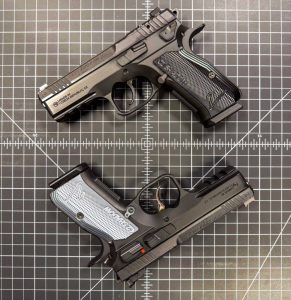
 CZ Shadow 2 vs CZ 75: What Sets Them Apart?
CZ Shadow 2 and CZ 75 share a strong design heritage, but they serve different roles within the CZ handgun lineup. The CZ 75 is a historic platform introduced in 1975, while the Shadow 2 is a later development shaped heavily by the demands of competitive shooting. click HERE to contact us.
Understanding the relationship between these two pistols provides useful insight into how CZ evolved one of its most recognizable handgun designs over several decades.
CZ 75: The Original Foundation
The CZ 75 was introduced in 1975 in Czechoslovakia and became one of the most influential designs in the company’s history.
Its traditional hammer-fired double-action/single-action operating system, distinctive internal-slide configuration, ergonomic grip, and metal-frame construction helped establish its reputation among firearms enthusiasts and historians.
Importantly, CZ 75 is a family rather than one single configuration. Different versions, generations, and variants have appeared over the years.
CZ Shadow 2: A Competition-Focused Evolution
The CZ Shadow 2 represents a much later stage in the development of the CZ 75 concept.
Rather than simply reproducing the original pistol, CZ developed the Shadow 2 around the requirements of competitive shooting. Its design incorporates changes intended to provide characteristics valued in organized shooting sports.
The result is a pistol that retains recognizable CZ 75 lineage while having a distinctly competition-oriented identity.
CZ Shadow 2 vs CZ 75 at a Glance
Category | CZ 75 | CZ Shadow 2
Design origin | 1970s | Modern development
Design family | Broad CZ 75 platform | Shadow family within CZ 75 lineage
Operating system | Hammer-fired DA/SA on traditional variants | Hammer-fired competition-oriented design
Construction | Traditionally metal-frame | Competition-focused modern construction
Primary identity | Classic all-purpose platform | Competitive shooting
Variants | Extensive | Multiple Shadow 2 configurations
Historical role | Foundational CZ handgun | Evolution of CZ competition design
Exact specifications vary by model and production version, so comparisons should always be made between specific variants rather than assuming every CZ 75 is identical.
The Biggest Difference: Intended Role
The most important distinction is the purpose behind each design.
The CZ 75 began as a general-purpose pistol platform and subsequently expanded into numerous variants for different applications.
The Shadow 2, by contrast, was developed with competitive shooting as a central consideration.
That difference affects the design priorities of each platform.
Design and Ergonomics
Both pistols are known for CZ’s emphasis on ergonomics, but the Shadow 2 takes the concept further toward competition use.
The CZ 75’s grip became famous for its comfortable and distinctive shape. The Shadow 2 builds upon this foundation with competition-oriented changes to the grip, controls, and overall interface.
Ergonomics are subjective, however. Hand size, grip preference, and individual experience can significantly affect how a shooter perceives either platform.
Operating System
Traditional CZ 75 models use a hammer-fired double-action/single-action system, and the Shadow 2 remains within that general hammer-fired lineage.
This distinguishes both designs from CZ’s modern striker-fired P-10 family.
While the basic operating philosophy is related, individual controls and configurations can differ between specific CZ 75 variants and Shadow 2 models.
Anyone transitioning between models should become familiar with the exact firearm and receive appropriate professional instruction.
Construction and Handling Characteristics
Classic CZ 75 pistols are strongly associated with substantial metal-frame construction.
The Shadow 2 retains a substantial competition-oriented character while incorporating developments intended to improve its suitability for organized shooting sports.
The differences in configuration, balance, and dimensions contribute to different handling characteristics, which is one reason the Shadow 2 should be viewed as an evolution rather than simply a newer CZ 75.
Competition Shooting
Competitive shooting is where the Shadow 2 most clearly separates itself from the broader CZ 75 family.
The Shadow 2 was developed around characteristics valued by sport shooters, including ergonomics, controls, sighting systems, and overall consistency.
The CZ 75, meanwhile, has a much broader identity. While many CZ 75 variants have been used in competitive environments, the platform itself was not limited to competition.
The Role of the CZ 75 Shadow
Understanding the CZ 75 Shadow helps explain the transition from the original CZ 75 toward the Shadow 2.
The Shadow family emerged from CZ’s experience with practical shooting and represented an increasingly competition-focused interpretation of the platform.
The Shadow 2 subsequently built on that development, making it one of the most recognizable modern competition pistols associated with CZ.
Model Variations Matter
One common mistake when comparing the CZ Shadow 2 and CZ 75 is treating “CZ 75” as though it describes one exact firearm.
The CZ 75 family includes numerous variants with differences in:
* Frame configuration
* Size
* Sights
* Controls
* Safety systems
* Materials
* Intended application
A CZ 75B, CZ 75 Compact, CZ 75 SP-01, and competition-oriented variant can therefore have substantially different characteristics.
For an accurate comparison, identify the exact CZ 75 model before evaluating specifications.
CZ Shadow 2 vs CZ 75 for Collectors
Both platforms can be interesting from a collecting perspective, but for different reasons.
The CZ 75 has significant historical value because of its long production history and influence on modern handgun design. Different production periods and variants can make individual examples particularly interesting.
The Shadow 2 represents a more contemporary chapter in CZ’s competition-pistol development and may appeal to collectors interested in modern sporting firearms.
Which One Is Better?
There is no universal answer.
The CZ 75’s greatest strength is its historical significance and broad platform identity, while the Shadow 2 is strongly defined by its competition-oriented development.
Someone researching classic handgun design may be more interested in the original CZ 75 family. A shooting-sports enthusiast may be more interested in the Shadow 2’s specialized design philosophy.
The best comparison depends on the specific model, intended lawful use, training background, and individual preferences.
Safety and Responsible Ownership
Anyone handling either platform should understand fundamental firearm safety principles and receive appropriate professional training.
Follow the manufacturer’s documentation for the exact model, particularly regarding operation, inspection, maintenance, and storage.
Firearms should be stored securely and kept inaccessible to unauthorized individuals. Ownership, transportation, storage, and sporting use must also comply with applicable local laws.
Frequently Asked Questions
Is the Shadow 2 based on the CZ 75?
Yes. The Shadow 2 is part of the broader CZ 75 design lineage and represents a modern development of that platform for competitive shooting.
Is the CZ Shadow 2 a CZ 75?
It is closely related to the CZ 75 family, but the Shadow 2 is a distinct modern model with competition-focused development.
Is the Shadow 2 designed for competition?
Yes. Competitive shooting is a central part of the Shadow 2’s design purpose and reputation.
Are all CZ 75 models the same?
No. The CZ 75 is a broad family containing numerous variants with different features and configurations.
Final Thoughts
The CZ Shadow 2 vs CZ 75 comparison is ultimately a story of evolution.
The CZ 75 established the foundation in 1975 and became one of the most recognizable Czech handgun designs. The Shadow 2 took elements of that established architecture and developed them around the specialized requirements of competitive shooting.
The two therefore share an important heritage while serving different roles within CZ’s product history. Understanding that distinction makes it easier to appreciate why both remain significant to firearms enthusiasts, collectors, and shooting-sports communities.